
6-Foot Angled C7 TV Cord Kit
3.8 7 ratings
$21.95

Cord ends
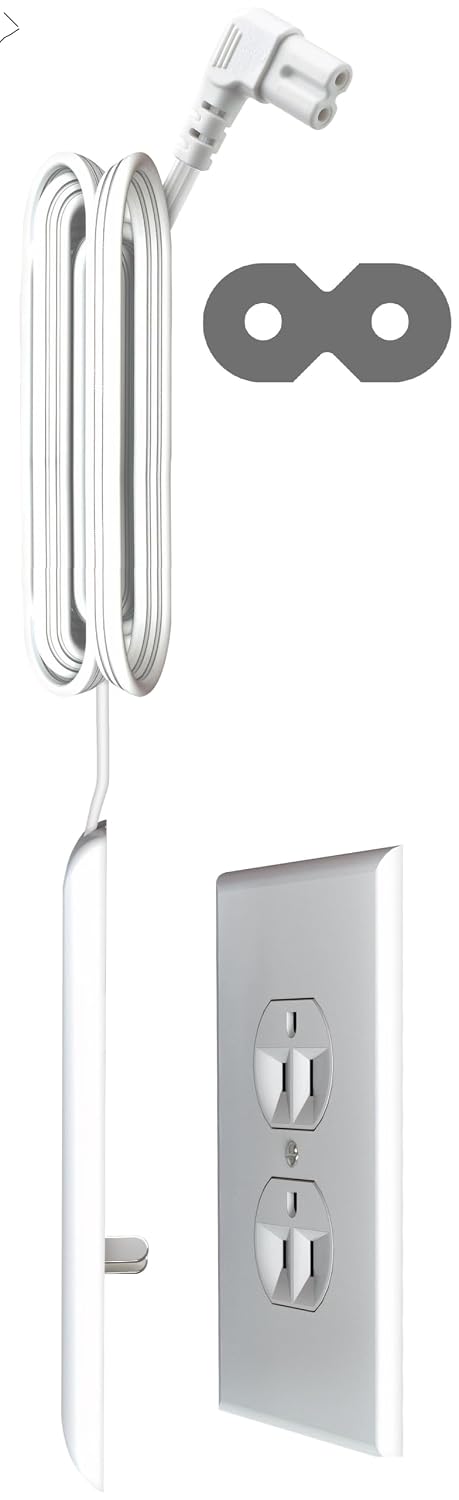
A television kit replaces the cord that came with the set, so the end that meets the television has to match the inlet molded into its back panel. Two shapes are in use and they are easy to tell apart once you know what you are looking for.
Both names come from IEC 60320, the international list of appliance couplers. It numbers them in pairs, so the end on the cord and the inlet it mates with are one apart.
| On the cord | Name | Mates with | Usually found on |
|---|---|---|---|
| Figure eight with two rounded lobes | C7 | A C8 inlet | Thinner televisions, monitors, sound bars, consoles, radios |
| Squarish block with three openings | C13 | A C14 inlet | Larger televisions, desktop computers, printers |
The figure eight comes in two versions, and this is where fitting goes wrong. On a non polarized end both lobes are rounded and the shape is symmetrical. On a polarized end one lobe is squared off along one side.
The inlet on the set follows the same pattern, and it only goes wrong in one direction. A squared end will not enter a fully rounded inlet at all, because the flat side has nowhere to go. A symmetrical end does enter a squared inlet, but it stands loose in the squared half instead of seating firmly.
So match the shape you can see. Look into the opening: one side cut flat means the polarized cord, both sides rounded means the symmetrical one. This is worth two seconds with a flashlight, because the two ends look nearly identical in a photograph and the whole difference is one corner.
The inlet is sunk into the back panel, usually low down near the rest of the connections and sometimes under a plastic flap. Printed beside it you will normally find the voltage and the current the set draws.
Compare the outline of the opening with the two shapes above. A small figure eight means a C7 kit. A wider block with three holes means a C13 kit. Nothing else on the back panel matters for this.
The kit takes its place. The cord that came with the television goes in a drawer, and it is worth keeping, because it is the one that goes back on if the set ever moves to another room or changes hands.
Measure from the outlet up to the inlet on the set, then add the slack the run needs at every turn. A mount that swivels needs enough cord to swivel with, and a set that sits on a stand still needs the cord to reach around the back of it.
Coming up short is the common mistake. A kit that only just reaches ends up pulling on its own clips, and the clips give before the cord does.
3.8 7 ratings
$21.95

4.6 4 ratings
$20.95

5.0 1 rating
$22.95
$20.95
Wall notes